Showing posts with label Arabic cuisine. Show all posts

Friday, May 1, 2015

Хумус със затаар и маслини


Предлагам ви идея за това как да си направите бързо и лесно хумус у дома.  Аз лично обичам да го хапвам с пиперки и сирене, а съпругът ми с пърленки.
  • ·       540 мл сварен нахут от консерва
  • ·       120 гр  тахини (сусамова паста)
  • ·       Сок от лимон, лимон и половина (на вкус)
  • ·       3-4 счукани скилидки чесън
  • ·       50 мл зехтин (аз ползвам олио от гроздови семки)
  • ·       1 к.л. сусамово олио, (това е моята секретна  съставка ;))
  • ·       Сол на вкус
  • ·       1-2 с.л. вода ако е необходимо*
  За заливката:
  • ·       Затаар** и олио
  • ·       Маслини  за гарниране

Продуктите се смесват в блендер докато се получи  фина паста. Ако е необходимо, можете да добавите 1-2 с.л. вода за по-фино мелене или да увеличите количеството на лимоновия сок. Обикновено свареният нахут в консерва съдържа определено количество вода, която можете да ползвате наместо обикновена такава.  Аз обаче я прецеждам и изплаквам зрънцата преди да ги сложа в блендера. Купувайте консервиран нахут, за който сте сигурни, че е добре сварен, т.е. мек и може да се пасира лесно и няма допълнителни  добавки и консерванти.
**Затаар-това е микс от сухи подправки, популярен в Средния Изток.  Смесете няколко супени лъжици затаар с олио и залейте готовия хумус.

Wednesday, June 18, 2014

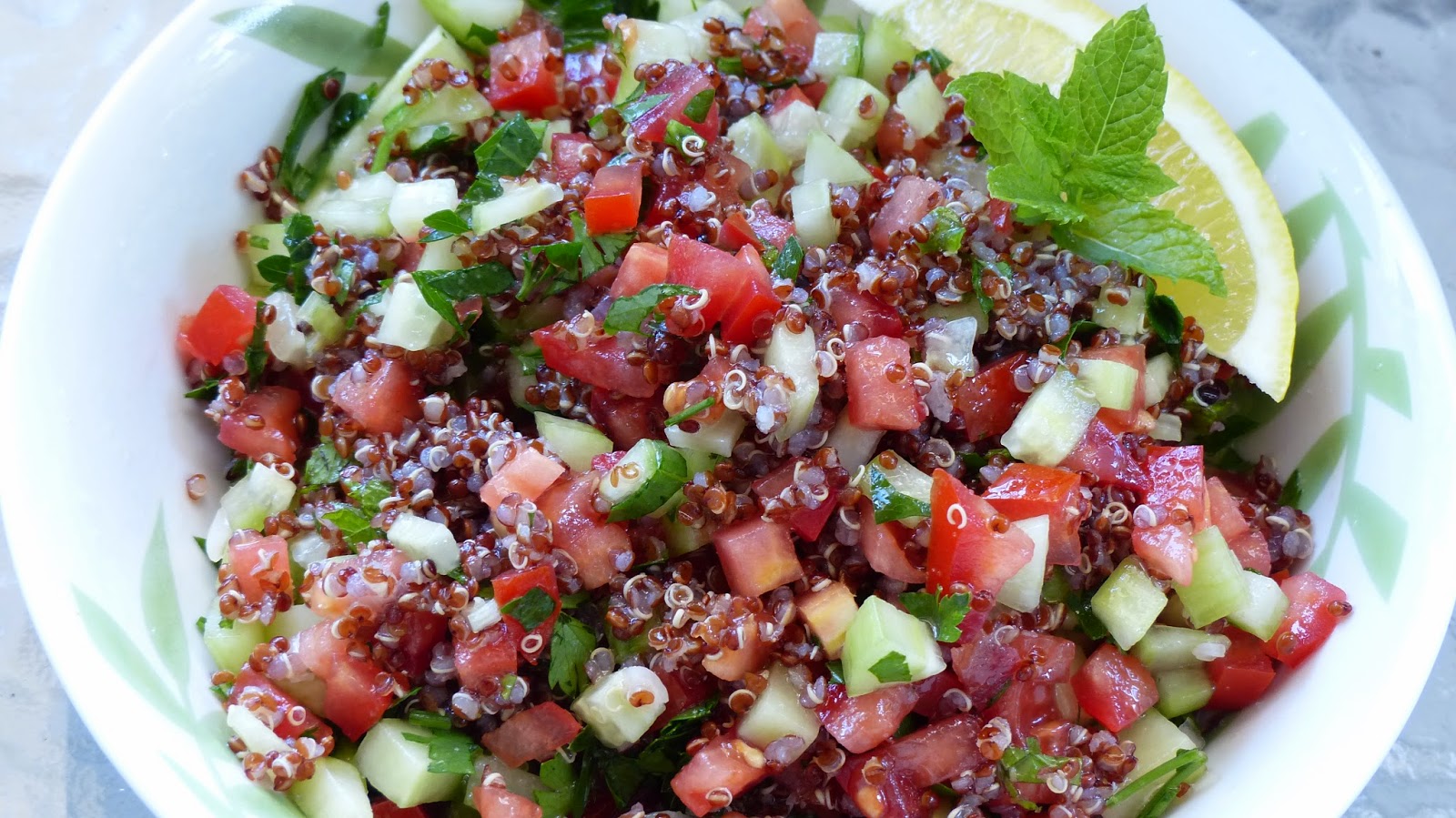
Табуле с киноа


·       1/2 ч.ч. киноа

·       2 средно големи домата

·       1 краставица, обелена

·       няколко стръка зелен лук

·       пресни листа отмагданоз и джоджен, на вкус

·       прясно изцеден лимонов сок, сол и зехтин или олио от гроздови семки

·       2 капки сусамово олио


Киноата се сварява в подсолена вода до омекване, след което се отцежда и оставя да изстине. Зеленчуците се нарязват на малки кубченца и се смесват с киноата. Табулето се подправя със зелените билки и останалите подправки на вкус.

Saturday, June 18, 2011

Fried zucchini and garlic-yogurt dip / Пържени тиквички


This is very popular Bulgarian dish usually served at summer time, as appetiser. Identical dish is well known in India, Iran, Turkey, Greek, and Italy although its origins come from Arab countries.
However the dip may have slight variations. Sometimes small amount of vinegar is used instead yogurt.

To fry vegetable (zucchini or eggplant) properly you need to remove some amount of its watery content. It will reduce the cooking time in double. Slice the vegetable and sprinkle it with salt. Let the slices to drain for a while over paper towel. Dip each peace into flour and fry from both sides in a hot oil. Drain the remaining oil on paper towel.

Garlic-yogurt-dill dip

4-7 garlic cloves
1 cup yogurt
bunch of fresh dill
salt and black pepper to taste

Crush the garlic cloves in a mortar, thus making a fine paste. Chop the dill, mix all together. Season it.

Serve as appetiser with grape or plume brandy- rakia.

Tuesday, October 12, 2010

Traditional desserts in Bulgaria and Balkans

After centuries of stormy history, intensive geographical and political changes and interaction of the Balkan countries with the Orient, it is difficult to define strictly the origin of the local cuisine. Many of the dishes have Turkish or Greek names, and have equivalents all around the Balkans and even in some central European countries. Some of the traditional lokal desserts are:

Halva - this is a hard sweet substance prepared from milled cereals or seeds, oils and nuts.

Lokum - a soft, sticky sweet dessert with different colours and taste usually rolled in icing sugar.

Gris-halva - a thin syrup cake made of semolina, cinnamon, nuts etc.


Baklava- is a rich, sweet pastry made of layers of phyllo dough filled with chopped nuts and sweetened with syrup or honey. It is very sweet. It is similar to saralia, tulumbi, revane, kadaif.

 Tulumbi - fried dough sweetened with syrup


 Mekitzi- fried dough with icing sugar and cinemmon.


Oshav - this is compote of dried fruit, boiled in water spiced with honey, cinnamon, clove, lemon peel, etc. It is a very pleasant, light and fresh dessert. It can be consumed both, cold or slightly warmed.

Sutlyash – cooked rise and milk, sugar and cinnamon.


Ashure - boiled wheat grains with grinded walnuts, biscuits, raisins, lemon peel and sugar.

Tikvenik – sweet phyllo pastry with pumpkin filling. It might contain nuts and aromatic spices such as cinnamon, vanilla, etc.

Sweet Banitza / Milk Banitza - Classical Banitza prepared whit sugar and milk.

Roasted pumpkin, honey and walnuts.

Rachel- roasted pumpkin in milk and sugar.

Yogurt with honey and jam or berries.


Gris-halva

4 oz gris (semolina)
3 oz sunflower oil
1 ½ cups water
1 cup sugar
1 tbsp cinnamon
½ cup walnuts (optional)
raisins (optional)
sweetened shredded coconut meat (optional)
lemon peels (optional)

Boil sugar and water to make syrup. Fry semolina in oil until golden. Add cinnamon and stir well. Sugar syrup is poured gradually fried semolina. Stir constantly over low heat until the semolina absorbs syrup. Pour into suitable container or individual pudding cups. Live it about an hour to cool down. Then cut into shapes as desired. It can be garnished with cinnamon, raisins, shredded coconut meat, and walnuts. If using vanilla and lemon peel, they are put in hot sugar syrup.


Tuesday, September 14, 2010

Kiopoolu / кьопоолу / kyopoolu


Eggplant and pepper spread:

6 grilled and peeled red bell peppers
2-3 grilled and peeled eggplants

3 medium size peeled and seeded tomatoes
4-5 crushed cloves garlic
5 tbsp of fresh and chopped parsley
5 tbsp sunflower oil
2 tbsp cider vinegar
 salt (more or less to taste)


Grill eggplants and peppers, until blackened. Cut eggplant lengthwise so the bitter juices will drain. Transfer to a heatproof bowl and cover with plastic wrap to steam. When cool enough to handle, remove skins.

Puree eggplant and peppers in a food processor until smooth. Pour into a bowl and add the rest of the other ingredients.

***
A photograph is showing two more ideas for fans of this delicacy kyopoolu: divide into three parts: the first part leave plain; to the second part add mayonnaise, into third part add Bulgarian sheep feta cheese.

Sunday, September 12, 2010

Musaka / Мусака

Traditionally Bulgarian moussaka is made whit potatoes and minced meat (the most popular one). Onion, carrots, garlic, herbs, and tomatoes are added as well. Top layer is made from yogurt, eggs and flour or béchamel sauce whit eggs. Also are known moussaka with added mushrooms, musaka whit zucchini, which doesn’t include meat, and eggplant’s moussaka.

Moussaka

400 grams Minced meat pork or ground mix (60% pork and 40% veal meat)
4 large potatoes
1 carrot
Onion
2 garlic cloves
3-4 tomatoes (depends on size)
2 tbsp Paprika
3 tbsp Winter savoury (if you don’t have it substitute whit oregano and thyme)
Black pepper and salt
60 mL Sunflower oil


For you I have chosen to show two of the variations whit photos, but the proportions below are for one full topping.

For the top layer (first variation):

http://picasaweb.google.ca/margatyna/HowToMakeIt#5511391603887457058

300 grams yogurt
4 eggs
2 tbsp flour
salt and black pepper

Second variation:

http://picasaweb.google.ca/margatyna/HowToMakeIt#5511391534909177266

400 mL milk
3 eggs
50 grams butter
3 tbsp flour
salt and black pepper


Preparation:

Garlic onions and carrots are braised in oil.
http://picasaweb.google.ca/margatyna/HowToMakeIt#5511391309098730258
Potatoes are added as well…
http://picasaweb.google.ca/margatyna/HowToMakeIt#5511391329525214098
After couple minutes is time for the meat and averting is stir well.
http://picasaweb.google.ca/margatyna/HowToMakeIt#5511391356630889298


http://picasaweb.google.ca/margatyna/HowToMakeIt#5511391381310183042

The mixture is spiced and puréed tomatoes are already added.

http://picasaweb.google.ca/margatyna/HowToMakeIt#5511391408475335378

http://picasaweb.google.ca/margatyna/HowToMakeIt#5511391435182925810

The hole mixture is placed on baking tray.
http://picasaweb.google.ca/margatyna/HowToMakeIt#5511391470927975858

Water is added just to cover a bit, than it is baked -230C about 20 min or until it’s done.
http://picasaweb.google.ca/margatyna/HowToMakeIt#5511391696951258274

Here I’ve got béchamel and eggs toping. http://picasaweb.google.ca/margatyna/HowToMakeIt#5511391663751241298

And the most lighter one whit yogurt and eggs. http://picasaweb.google.ca/margatyna/HowToMakeIt#5511391634514760322

I made both of them just to show you the final result: left: béchamel and eggs / right: yogurt, flour, and eggs
http://picasaweb.google.ca/margatyna/HowToMakeIt#5511391716076180658
http://picasaweb.google.ca/margatyna/HowToMakeIt#5511391747715503394

The composed dish is baked until the top layer is browned. Moussaka is usually served lukewarm. It helps to keep its shape.

http://picasaweb.google.ca/margatyna/HowToMakeIt#5511391823441852210